Community
HEIDEDAL SHOULD BE PART OF THE CONVERSATION
UFS veterinary school could create opportunities far beyond the South Campus
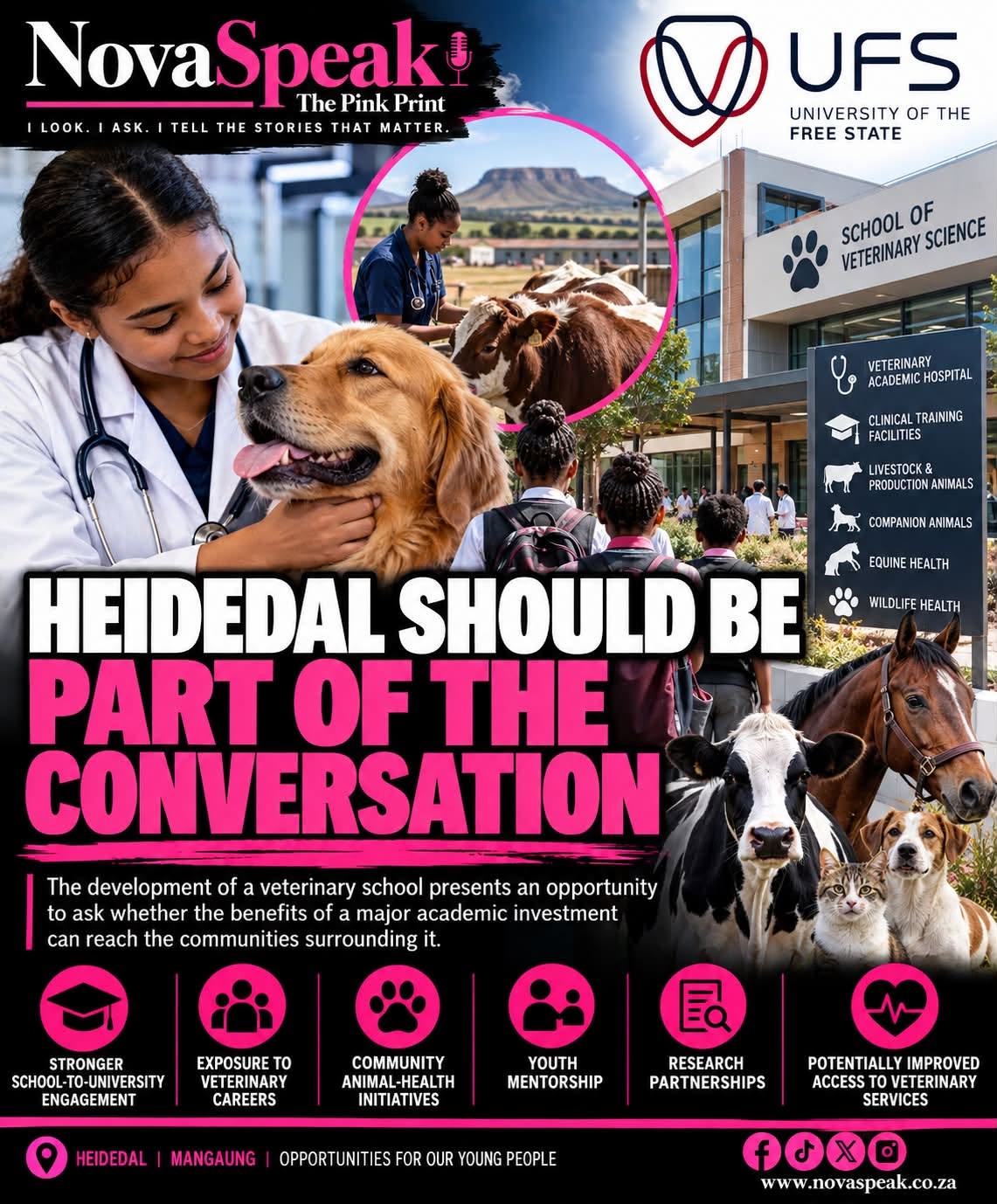
BLOEMFONTEIN — The University of the Free State's plans for a School of Veterinary Science could become one of Mangaung's most significant academic investments, but there is a question that should be asked before the first students walk through its doors: how much of this opportunity will reach the communities living around the South Campus — and will Heidedal be part of that conversation?
The proposed six-year Bachelor of Veterinary Science programme, Veterinary Academic Hospital and dedicated clinical training facilities represent far more than another university development. Veterinary science connects directly to animal health, agriculture, food security, public health, environmental sustainability and economic development, giving the project the potential to influence not only the university but the wider Mangaung community.
That potential, however, will depend on what happens beyond the campus boundary.
For Heidedal, the issue should not simply be that a major academic institution is developing nearby. The more important question is whether young people, schools, community organisations and residents will be positioned to participate in the opportunities that could emerge from it.
A university can build world-class facilities, produce highly qualified professionals and expand its academic footprint, but if surrounding communities remain spectators, the broader social value of that investment becomes much harder to measure.
Heidedal should therefore not be looking at the proposed veterinary school simply as something being built next door.
It should be asking what can be built with the community.
Imagine a learner from a Heidedal school being introduced to veterinary science before matric. Imagine schoolchildren visiting the South Campus, meeting veterinary professionals, observing clinical training and discovering that veterinary medicine is not an inaccessible career reserved for someone else's child.
Imagine mentorship programmes connecting university students with learners from surrounding schools, or outreach initiatives introducing young people to careers not only as veterinarians but across the wider animal-health sector.
Those opportunities will not happen automatically.
They require deliberate engagement.
The UFS has indicated that the development of veterinary education involves engagement with veterinarians, para-veterinary professionals, government, industry and other stakeholders. That same principle should extend to the communities surrounding the institution.
Because Heidedal should not merely be a neighbourhood located next to a university.
It should be a community connected to what that university creates.
The proposed Veterinary Academic Hospital could provide another avenue for that relationship. Depending on the final model and regulatory requirements, the facility could create opportunities for community outreach, animal-health education, research and engagement around responsible animal ownership and access to appropriate veterinary services.
For a community with families, schools, pet owners and young people, that conversation has practical relevance.
But the opportunity is bigger than pets.
Veterinary medicine sits within a much wider system involving livestock, agriculture, food production, wildlife, disease prevention and public health. In a province with a substantial agricultural economy, a new veterinary school could contribute to developing skills that extend well beyond Mangaung and into the Free State's rural and agricultural communities.
That makes the proposed school potentially important not only as an educational project, but as part of the province's broader economic and human-capital development.
And that is precisely why Heidedal should be asking questions now.
Not after the programme is established.
Not after opportunities have already been allocated.
Now.
Will schools in Heidedal be included in veterinary career-awareness initiatives?
Will learners be exposed to veterinary science before they reach matric?
Will mentorship opportunities be created?
Could community organisations participate in outreach programmes?
Could local structures help identify learners who might otherwise never consider veterinary medicine as a career?
Could the Veterinary Academic Hospital eventually form part of a wider community animal-health outreach network?
And, perhaps most importantly, how will young people from communities surrounding the campus be encouraged and supported to compete for opportunities within the new academic environment?
These questions do not suggest that Heidedal should receive preferential treatment.
They suggest something much simpler: that communities should be included in conversations about developments that have the potential to affect their futures.
The proposed school is still progressing through the regulatory, accreditation and implementation processes required before the programme can fully take shape. That means there is an opportunity now to establish meaningful partnerships rather than trying to create them once everything is already operational.
The measure of a major university investment should therefore not only be the size of its buildings, the sophistication of its facilities or the number of graduates it produces.
It should also be measured by the doors it opens.
How many learners from surrounding communities begin believing that university is for them?
How many discover careers they had never considered?
How many gain access to mentorship?
How many communities benefit from research and outreach?
And how many young people who once looked at the university from the outside eventually find themselves walking through its doors?
For Heidedal, the proposed veterinary school presents an opportunity to place education, youth development, professional careers, community engagement and animal health around the same table.
But opportunity does not become access simply because it exists nearby.
Someone has to build the bridge.
The University of the Free State is developing a vision for veterinary education in the Free State. The question for Heidedal is whether it will be invited to help shape the community dimension of that vision — or whether residents will once again be expected to watch development happen around them and simply hope some of its benefits eventually reach their streets.
That is the conversation that should start now.
Because the South Campus should not merely be a place that sits beside Heidedal.
It should be a place whose opportunities can be seen, reached and felt by the young people who live there.
And if the proposed veterinary school is truly intended to serve the future of the Free State, then Heidedal should not be outside that future looking in.
NovaSpeak: The Pink Print
WE LOOK. WE ASK. WE TELL THE STORIES THAT MATTER.