Opinion
TWO VOICES, ONE SOUTH AFRICA
WHEN HISTORY MEETS THE STRUGGLE FOR WORK
AND WHERE DOES THAT LEAVE THE COLOURED SOUTH AFRICAN?
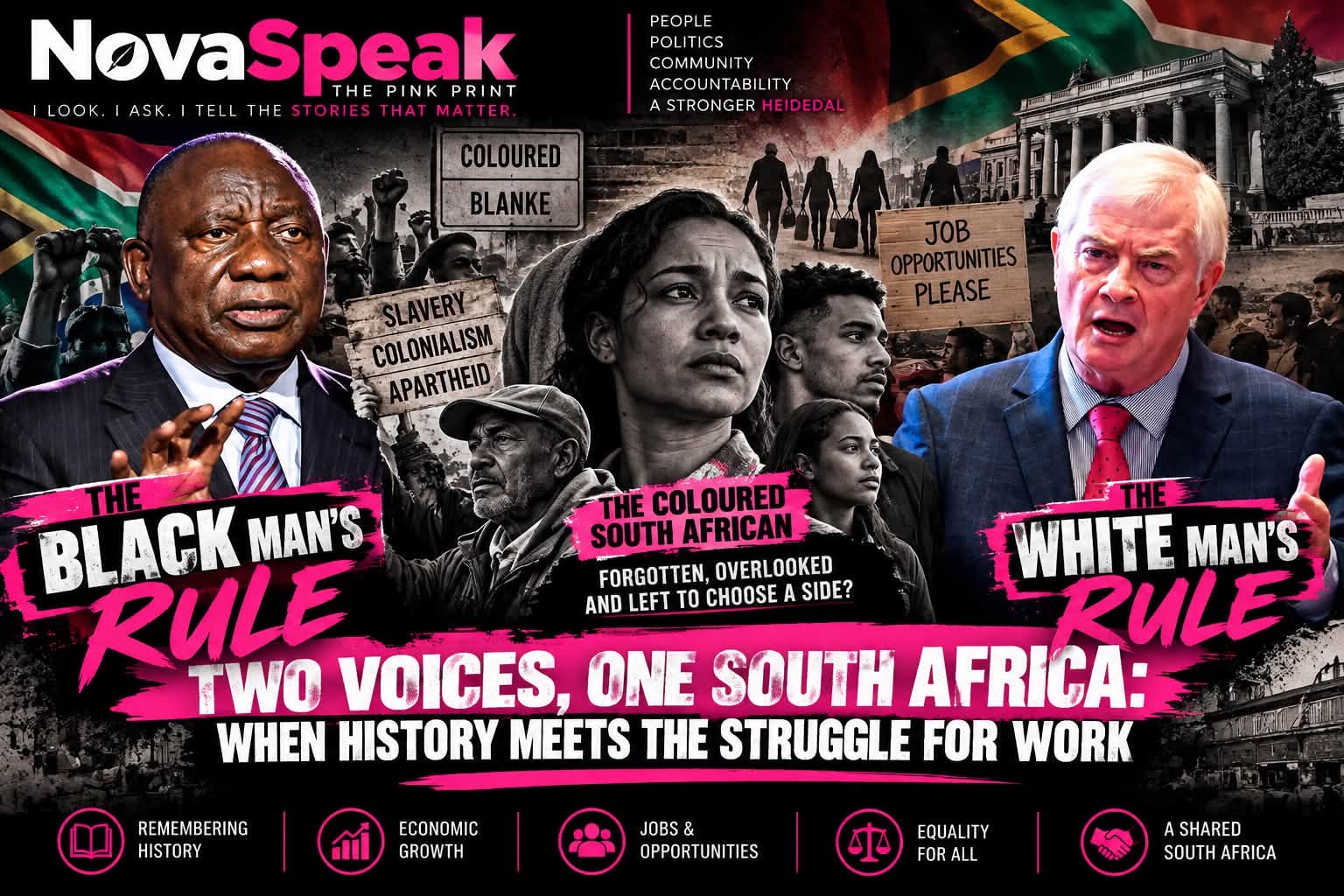
BLOEMFONTEIN — South Africa is having two conversations at once: one about remembering the injustices that shaped the country, and another about escaping the economic realities that continue to define millions of lives. But between those competing political emphases sits a question that deserves far more attention: where does the Coloured South African fit when the national debate is repeatedly reduced to Black versus White?
The question is not whether apartheid happened. It did. Nor is the country's unemployment crisis in dispute. It remains one of South Africa's defining challenges. The harder question is whether a country attempting to build a common future can adequately accommodate communities whose histories do not fit neatly into the political categories through which much of the national debate is conducted.
President Cyril Ramaphosa's Heritage Day address in Oudtshoorn on 24 September again placed historical memory at the centre of the national conversation, calling on South Africans to remember slavery, colonialism, apartheid, dispossession and forced removals, while also remembering the resistance and solidarity that helped produce democracy.
That historical memory matters. But so does what happens when the commemoration ends and people return to communities where unemployment, poverty, inadequate services and limited economic opportunity remain everyday realities.
South Africa's 2026 State of the Nation Address placed inclusive economic growth and job creation among government's strategic priorities, reflecting the reality that political freedom has not translated into economic security for everyone.
It is within that tension that the contrasting political emphases of Ramaphosa and Freedom Front Plus leader and Correctional Services Minister Pieter Groenewald become relevant. Their politics do not represent identical positions on the country's past, present or future. Ramaphosa's public arguments have repeatedly connected present inequality and economic exclusion to the country's history, while Groenewald and the Freedom Front Plus have placed greater emphasis on economic growth, employment, individual opportunity and opposition to race-based policies such as affirmative action and BEE.
The difference is important because it exposes a larger question facing South Africa: how does a country confront the consequences of its history while ensuring that today's citizens are not permanently defined by it?
And that question becomes particularly complicated for Coloured South Africans.
The temptation to describe South African politics through a simple Black-versus-White framework overlooks a substantial part of the country's history. Under apartheid, Coloured people were not outside the racial system. They were classified by it, segregated under it and displaced by it.
The Group Areas Act became one of the central instruments through which apartheid's racial geography was imposed, resulting in the forced removal of Black, Coloured and Indian communities from areas designated for other racial groups. Millions of people were displaced from homes and communities as apartheid legislation determined where South Africans could live, work and own property.
The Coloured experience is therefore not a footnote to South African history.
It is part of it.
Yet the political conversation can sometimes leave Coloured communities confronting a second problem: being historically included when discussing apartheid, but less visible when contemporary political narratives are constructed around two dominant racial categories.
That creates a difficult space for the Coloured South African who can simultaneously acknowledge historical injustice and demand immediate economic opportunity.
A young person looking for work does not experience unemployment as an ideological debate. They experience it through another unanswered application, another month without income and another year in which plans for education, housing, independence or starting a business are postponed.
Likewise, a family living in a community with failing infrastructure does not experience service delivery as an abstract policy argument. They experience it through unreliable services, deteriorating public spaces, unsafe neighbourhoods and the daily cost of trying to make a life work.
This is where the national conversation risks becoming too narrow.
Remembering history is necessary.
But remembering history does not create a job.
Economic growth is necessary.
But economic growth, on its own, does not erase the accumulated consequences of historical inequality.
South Africa therefore faces a difficult balancing act: confronting historical disadvantage without reducing every contemporary citizen to the racial categories imposed upon previous generations.
For Coloured South Africans, that tension can be especially sharp.
They can say: I remember apartheid. I remember forced removals. I remember racial classification. I remember what happened to my community.
And at the same time they can say: I want a job. I want safer streets. I want functioning schools. I want decent housing. I want economic opportunity. I want competent government.
Those demands do not contradict one another.
They are part of the same democratic expectation.
The Constitution's commitment to equality, dignity and non-racialism presents South Africa with precisely this challenge: to acknowledge where the country came from while building a society in which people's futures are not permanently confined to the categories created by that past.
The 2026 Heritage Day theme, “Celebrating Our Living Heritage: Strengthening the Ties That Bind Us,” similarly placed unity, social cohesion, Ubuntu and shared belonging alongside the responsibility to remember the country's history.
That raises questions that cannot be answered by slogans.
Can South Africa confront slavery, colonialism and apartheid without reducing today's citizens to the identities imposed upon their ancestors?
Can it pursue economic growth without pretending that everyone began from the same starting point?
Can it address historical inequality while ensuring that race does not become the permanent definition of every individual?
And perhaps most importantly, can a Coloured South African participate fully in the country's political future without being expected to choose a side in a Black-versus-White argument?
The answer cannot simply be found in deciding which political narrative is more important.
South Africa needs a conversation large enough to accommodate both.
History must be remembered because forgetting it risks repeating its consequences.
Economic growth must be pursued because political freedom without meaningful opportunity leaves too many people excluded from the material benefits of democracy.
Jobs matter.
Education matters.
Safety matters.
Housing matters.
Infrastructure matters.
Economic participation matters.
Dignity matters.
And historical justice matters.
The challenge is not to make one of these priorities defeat another, but to build a political conversation capable of recognising that they exist simultaneously.
Because South Africa's history is not a story of only two communities.
It is a story of Black South Africans, Coloured South Africans, Indian South Africans, White South Africans and countless individuals whose experiences of oppression, privilege, displacement, resistance and survival cannot always be contained within neat political categories.
Perhaps, then, the question is not whether South Africa has two voices.
Perhaps it is whether the country is listening to enough of them.
The Coloured South African should not have to choose between remembering where the country came from and demanding where it should go.
They should not have to exist as an electoral voting bloc when politicians need votes, nor as a historical footnote when the country discusses apartheid.
They should be able to demand accountability, opportunity, safety, dignity and economic inclusion on their own terms.
Because the measure of South Africa's democracy cannot simply be whether one racial narrative defeats another.
It must also be whether every South African can see themselves in the country's future.
Including the Coloured South African.
Not as an afterthought.
Not as a voting bloc.
Not as a political category waiting to be claimed.
But as a South African.
NovaSpeak: The Pink Print
WE LOOK. WE ASK. WE TELL THE STORIES THAT MATTER.