News
MANGAUNG’S EMPTY GATEWAY
WHAT DOES A CITY ASK TOURISTS TO SEE WHEN ITS OWN TRANSPORT HUB SITS SILENT?
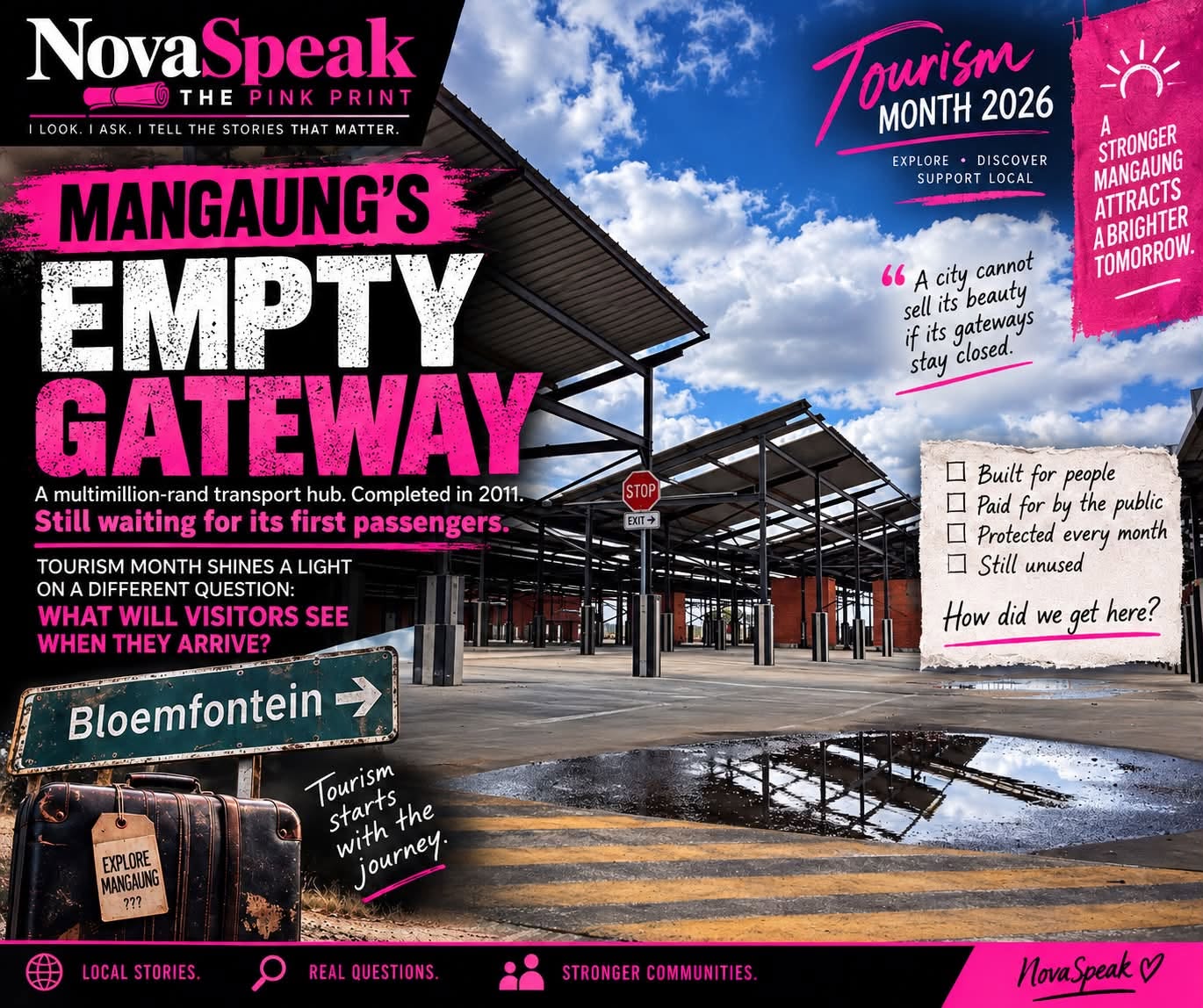
September is Tourism Month, and South Africa is being encouraged to rediscover its own destinations under the 2026 theme, “Growing South Africa’s Tourism Sector in the Digital Era.” The message is simple: travel begins at home. But in Mangaung, perhaps the more uncomfortable question is what visitors encounter when they arrive home — and what they see before they even get the opportunity to explore the city.
Because sitting quietly in the heart of Bloemfontein is a multimillion-rand piece of infrastructure that was supposed to help people move through the city — commuters, taxi passengers and long-distance travellers — yet more than a decade after its completion, the facility remains largely empty.
It was completed in 2011 with an ambition far bigger than simply being another taxi rank. It was designed as an integrated public transport facility, with space for taxis, long-distance buses, passenger boarding, taxi holding areas, a wash bay, offices and retail outlets.
Today, however, the question almost writes itself:
How does infrastructure built to move thousands of people end up becoming a place where hardly anyone goes?
A recent visit to the facility found security personnel still stationed there, while large sections of the building remain largely unused. Instead of the constant movement associated with a major transport interchange, there is an eerie quietness — with birds among the few visible signs of life inside.
And that is where Mangaung’s tourism story becomes more complicated.
The province is actively promoting the Free State as a destination for business, investment, lifestyle, sport and leisure, while Tourism Month encourages people to explore what is on their doorstep.
But tourism is not only about beautiful photographs, attractions and promotional campaigns.
It is also about the journey.
Where does a visitor arrive?
How do they move around?
What does the city look like when they arrive?
And what happens when public infrastructure designed to support that movement simply doesn’t function as intended?
Mangaung Metro says the facility was never intended to operate as an ordinary taxi rank. According to Nokuthula Chakane, the municipality’s HOD for planning, human settlements and economic development, it was conceived as part of a broader integrated transport system that would eventually connect different modes of public transport.
But that vision collided with reality.
Taxi operators raised technical concerns after completion, including issues around ventilation and entrance sizes. There were also contractual disputes involving the Greater Bloemfontein Taxi Association and its business entity.
More than a decade later, those unresolved issues have not simply remained frozen in time.
Time has its own bill.
A facility that is not being used still needs to be guarded. It still deteriorates. It can still be vandalised. Infrastructure can still be stolen.
The municipality currently spends approximately R205,955 every month on security at the facility — money being spent to protect infrastructure that is not currently fulfilling the transport purpose for which it was built.
That works out to roughly R2.47 million a year just for security, before the cost of repairs, maintenance, rehabilitation or whatever future intervention may ultimately be required.
And there is another uncomfortable detail.
The municipality is not currently generating revenue from the facility, although some ground-floor tenants occupy space under a previous contractual arrangement.
So the building sits.
Security guards remain.
Cameras are installed but reportedly not operational because of cable theft.
And the city continues to pay to protect it.
The municipality says it now needs a comprehensive technical assessment before it can determine exactly what needs fixing and what reopening the facility would cost. No final repair figure or implementation timeline has yet been determined.
There are also discussions about potentially expanding the facility, including an extension for long-distance taxi services.
But before another brick is laid, another rand is spent or another ribbon is cut, perhaps Mangaung needs to confront a more basic question:
What went wrong with the first vision?
Because this is not merely a story about an empty building.
It is a story about the distance between planning and execution.
It is about what happens when infrastructure is completed but the ecosystem it was designed to serve never materialises around it.
It is about whether cities can afford to leave expensive public assets sitting idle for years while communities continue to experience transport challenges.
And, particularly during Tourism Month, it raises another question worth asking:
Can Mangaung sell itself as a destination if the city’s own gateways remain unfinished stories?
The municipality says the facility’s future must be considered alongside Mangaung’s wider public transport network, including Hauweng buses, conventional buses, long-distance services and taxis. Traffic counts, traffic-impact assessments and further planning studies are expected to guide any future changes.
That may be necessary.
But perhaps the most important study is one that has nothing to do with traffic counts.
It is the study of what happened between 2011 and 2026.
Fifteen years is a long time.
Long enough for a transport hub to become a thriving interchange.
Long enough for a project to be repaired, redesigned or repurposed.
And apparently long enough for a multimillion-rand public facility to become part of Bloemfontein’s urban furniture — so familiar in its emptiness that people can walk past it without asking why it is still there.
Tourism Month tells South Africans to take a Sho’t Left, discover their own country and spend their tourism rand locally.
Perhaps Mangaung’s challenge is even closer to home.
Before asking the world to discover Mangaung, what happens when we rediscover the infrastructure already sitting in the middle of it?
NovaSpeak asks: Who was this facility built for — and when will those people finally get to use it? See less
Comments
No comments yet
Be the first to comment.