Politics
HEIDEDAL IS NOT A VOTE — SO WHERE ARE THE RESULTS?
If political parties want our votes, they must be prepared to account for what they have done with our trust.
If political parties want our votes, they must be prepared to account for what they have done with our trust.
There is a question Heidedal should be asking every political party that comes knocking before the 2026 Local Government Elections: what have you actually done for us? Not what you promise to do, not what your manifesto says, not what your candidate says on a campaign stage and not what appears on a glossy poster. What have you done?
For decades, communities such as Heidedal have heard the familiar language of political courtship. Jobs will come, services will improve, housing will be addressed, infrastructure will be fixed, young people will be given opportunities, communities will be safer and residents will be heard. Then the election ends, the posters disappear, the political meetings become less frequent, the microphones move elsewhere and the community is left with the same streets, the same frustrations and, too often, the same unanswered questions. That is precisely why this election should be different.
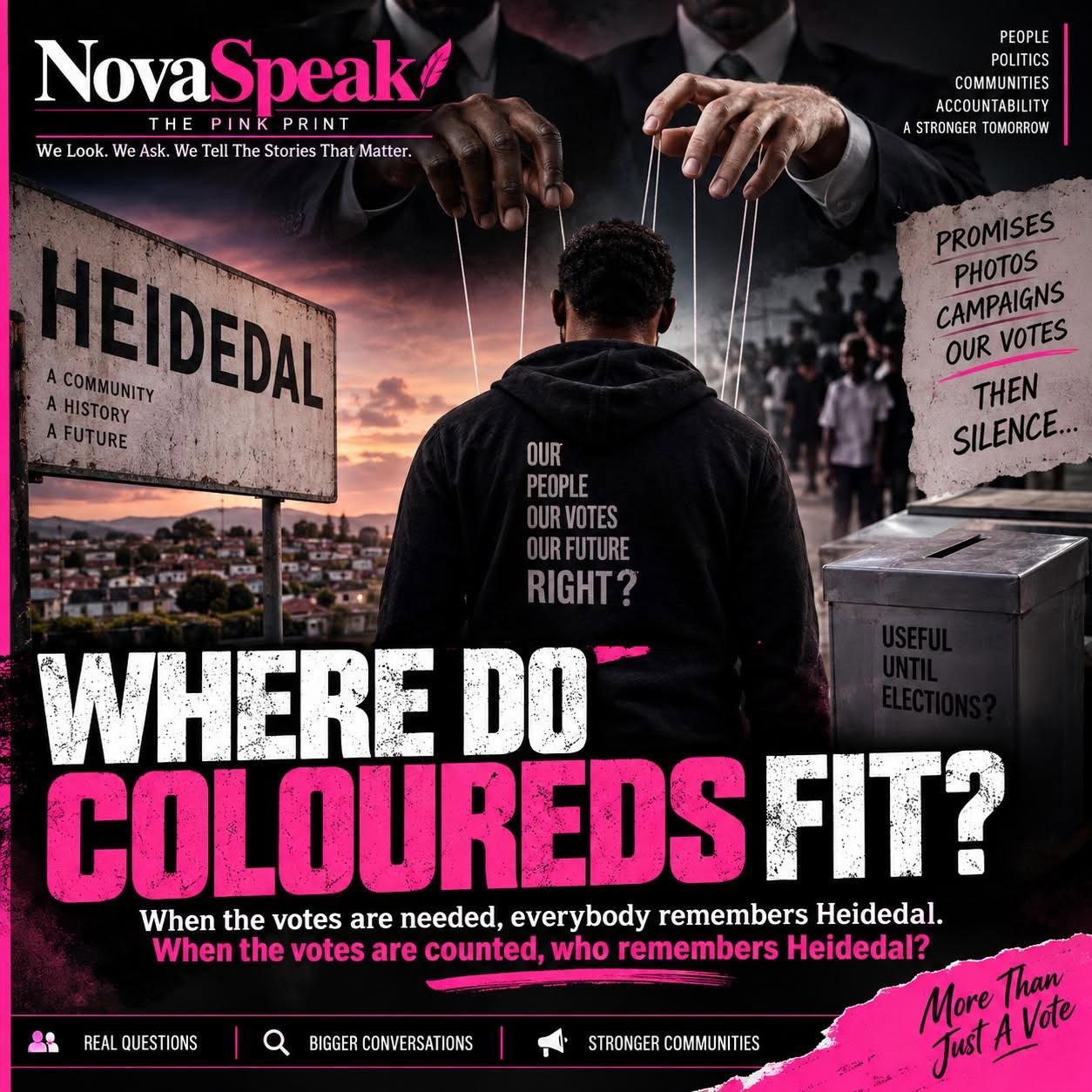
Heidedal should not approach the ballot box as a community waiting to be persuaded. It should approach it as a community demanding accountability, because the people asking for its vote should also be prepared to account for the trust they are asking residents to place in them. Gregory Werner puts that issue bluntly by asking whether Coloured communities are being treated as political citizens with genuine power or as voting blocks that become useful when elections arrive.
Werner argues that for decades Coloured communities across South Africa have been courted as reliable voting blocs, promised economic upliftment and praised during election cycles, only to find themselves ignored once the ballots have been counted. But the question does not stop with political parties. It also turns inward and asks what our own organisations and leaders have done in Heidedal. That question cuts both ways, because accountability cannot suddenly become important only when the politician we dislike is involved.
If an ANC representative has failed, ask the ANC. If a DA representative has failed, ask the DA. If the PA has made promises, ask where the results are. If the Freedom Front Plus wants Heidedal’s support, ask what it has delivered and what role it intends to play. The same standard must apply to everyone. That is not political hostility. That is democracy.
Perhaps this is where Heidedal needs to change the way it conducts its political conversations. Too often, communities become accustomed to judging political parties by what they say about one another instead of what they can demonstrate about themselves. Candidates attack opponents, parties defend their records, supporters defend their parties and community members argue across social media, while somewhere in the middle of all that political noise, the pothole remains, unemployment remains, the housing problem remains, safety concerns remain and deteriorating public spaces remain.
Residents are then expected to wait for the next campaign season to hear that change is coming. Enough. If a political party says it represents Heidedal, residents should be able to ask that party to show its local leadership structure, identify its candidates, explain who is responsible for decisions and demonstrate how local residents are being incorporated into meaningful political structures.
If a party claims to empower the community, then residents should ask: who from this community has actually been empowered? If it promises jobs, ask where the jobs are. If it promises better services, ask where the measurable improvements are. If it promises representation, ask where Heidedal is when the important decisions are being made. And if it asks for another five years, ask the most uncomfortable question of all: why should we trust you again?
That question should not frighten anyone seeking public office. It should be expected. A councillor is a public representative, not a political celebrity. A candidate is asking for authority over public resources and decisions that affect people's daily lives, and voters therefore have every right to scrutinise the person, the party and the record behind the campaign.
That scrutiny also means political representatives cannot demand that political criticism remain polite enough to make everyone comfortable. If a DA representative and a PA representative are publicly debating political issues, then the parties they represent are naturally part of that discussion. Pretending otherwise does not make the debate more mature; it makes it less honest. As one representative put it during the discussion, if public representatives are going to speak about politics, municipalities and their constituents, they must also be prepared to identify and defend the parties they represent.
That is precisely the point: say the name, defend the record and answer the question. That is what political accountability looks like.
But accountability must extend beyond political parties themselves. Heidedal should also question its own community leadership. What have our organisations achieved? Which promises were followed through? Which initiatives created lasting change? Where have leaders successfully challenged government, where have they failed and, perhaps most importantly, where are the young people in these conversations?
It is not enough to complain that young people are disengaged from politics while political structures continue speaking around them instead of with them. If councillors genuinely care about Heidedal, they should sit down with residents — young and old — and have an honest conversation without the usual political theatre. Better still, let the candidates debate one another in front of the community.
Put them in the same room. Give them the same questions. Ask them about jobs, housing, safety, infrastructure, public spaces, municipal finances and youth development. Then let residents decide who answered convincingly and who simply performed. Because political accountability becomes meaningless when politicians are allowed to speak only in controlled environments.
Heidedal deserves a proper public debate — not a rally, not a party meeting, but a debate where candidates can be challenged directly and voters can hear what each party intends to do and, more importantly, how it intends to do it. Saying “we will fix it” is easy. Explaining how, with what money, by when and under whose responsibility is considerably harder. That is the standard voters should demand.
And that standard should not disappear once the votes have been counted. Accountability cannot begin six weeks before voting day and disappear the morning after. If a candidate promises something in October, residents should be able to ask about it in December. If a councillor promises action in January, residents should be able to demand an update in March. If a municipality promises a project, residents should know who is responsible, what the deadline is and what happens if that deadline is missed.
That is how political trust is built — not through speeches, but through follow-through.
The political debate around Heidedal also needs to confront another uncomfortable reality: representation is not the same thing as power. A community may see familiar faces on campaign posters and still ask whether those representatives have meaningful influence within their parties and within municipal decision-making structures. Having someone who looks like the community, speaks its language or understands its history on a poster is not enough. Representation must eventually translate into influence, opportunity and results. Otherwise, what exactly are residents being represented in?
That is a question political parties should answer without becoming defensive, but it is also a question Heidedal voters should ask themselves, because the vote is powerful only when voters understand that it belongs to them. No political party owns it. No councillor is entitled to it. No candidate deserves it simply because they arrived with a promise. The vote is a contract of trust, and trust should be earned.
Heidedal therefore has an opportunity in 2026 to change the political conversation. Instead of asking which party is the loudest, ask which party is prepared to be measured. Instead of asking who has the most attractive manifesto, ask who has a credible implementation plan. Instead of asking who can mobilise the biggest crowd, ask who can produce the biggest measurable improvement. And instead of allowing politicians to tell residents what they want to hear, make them answer what residents actually want to know: where are the results?
That should be the accountability test, and it should not matter whether the answer comes from the ANC, DA, PA, Freedom Front Plus or any other political organisation. If they want the vote, they must face the questions. If they want public office, they must accept scrutiny. If they want to represent Heidedal, they must be prepared to account to Heidedal.
Because after the election, the politicians can go home. The parties can move on to the next campaign. The posters can come down. But Heidedal remains. The residents remain. The problems remain. And the people who made promises will eventually have to face the people who remember them.
So perhaps the question for 2026 is not simply, “Who are you voting for?” Perhaps the better question is: “What has your vote achieved?”
And if the answer is nothing, voters have every right to ask whether continuing to give their political loyalty without demanding measurable results is serving the community at all.
Heidedal does not need politicians who merely remember the community when they need its votes. It needs representatives who remember the community when there are no elections. That is the difference between being courted as a voting bloc and being respected as a political constituency.
One wants your vote. The other understands your power.
Heidedal must decide which one it is prepared to accept.
NovaSpeak | The Pink Print
We Look. We Ask. We Tell The Stories That Matter.