Opinion
“The power is in the people, but a reason to rise.”
A chat with Mr Hattingh: refusing to see his community go to waste
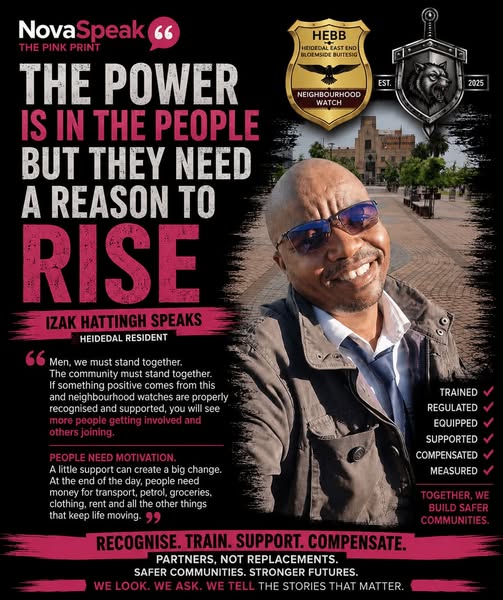
There are people in every community who complain about what is going wrong. There are also those who decide that complaining is not enough.
Izak Hattingh is one of them.
A lifelong resident of Heidedal, a single guardian and an active neighbourhood-watch member, Hattingh has spent years watching the community around him change. But what concerns him most is not simply the condition of the streets or the state of public spaces. It is what is happening to the children growing up in those spaces.
For Hattingh, the warning signs are everywhere: gangsterism, substance abuse, violence, poverty and difficult home circumstances that can leave young people searching for belonging in places that can ultimately destroy them.
And he refuses to simply watch it happen.
His involvement in the community is rooted in something deeper than volunteering. Hattingh describes himself as a kind of community parent — someone who feels responsible not only for his own family, but also for children who may be experiencing abuse, neglect or circumstances that threaten their development.
It is a responsibility he believes cannot be carried by parents alone.
“A child is not raised only by a mother and a father,” he says. “A child is also raised by the community.”
That sentence perhaps captures the heart of Hattingh's philosophy.
Because Heidedal's problems cannot be solved by one household, one neighbourhood watch, one organisation or one government department. The community's challenges have become too interconnected. When a child grows up surrounded by drugs, violence, poverty and instability, the answer cannot simply be to tell the child to make better choices.
The community has to give that child better choices to make.
That is why Hattingh believes neighbourhood watches should receive stronger recognition and support. He is not arguing that residents should replace the police or that volunteers should suddenly become law-enforcement officers. His argument is much simpler: people who are already willing to give their time to protect their communities should not be expected to carry the entire burden themselves.
“Men, we have to stand together. The community has to stand together,” he says.
“There are many of us who are already part of the neighbourhood watch, but people need some form of motivation. If members know that their hard work could result in some form of compensation at the end of the month, you will see more people becoming active and others joining.”
For Hattingh, this is not about getting rich from community work.
It is about recognising reality.
People have families to feed. They have transport costs. They need petrol to patrol. They have rent, groceries, clothing and other responsibilities. Asking people to repeatedly use their own resources to keep their communities safe may demonstrate commitment, but it is difficult to sustain indefinitely.
“At the end of the day, people need money,” Hattingh says.
“We are not asking for something unreasonable. Sometimes just a little motivation is needed. Give people a reason to get involved, and you will see momentum building.”
He reaches for an image that is easy to understand.
“It is like a motor that needs petrol to get from point A to point B. The neighbourhood watch is already there and the willingness is there — but sometimes people need that support to keep the engine running.”
It is a metaphor that speaks to a much bigger reality in Heidedal.
The willingness is there.
The people are there.
The concern is there.
What residents often lack is the support and structure to turn that willingness into something sustainable.
But Hattingh's vision for Heidedal does not stop with neighbourhood patrols. For him, keeping young people safe means addressing what happens before they become involved in crime.
That is where his idea for a youth camp comes in.
He imagines a structured programme where children and young people exposed to poverty, gangsterism, substance abuse, violence or troubled home environments can spend time in a safe and constructive environment.
Not simply a place where children are kept busy, but a place where they can be guided.
A place where they can learn discipline.
A place where they can participate in sport and education.
A place where they can receive mentorship.
And, where necessary, a place where they can be connected to professional assistance and rehabilitation services.
“I have an idea,” Hattingh says. “We should establish a camp where our children can receive the support they need.”
His concern is that too many young people are being exposed to adult problems long before they have developed the tools to deal with them.
“Many of them are trapped in poverty, gangsterism and problems at home. Some come from struggling families and need a safe place where they can receive guidance and, where necessary, be referred for rehabilitation.”
He believes children need adults who are prepared to do more than tell them what not to do.
“They need people who can train, discipline and advise them on how to walk through life. They need positive guidance and must be shown that there is another way.”
That “another way” is at the centre of his thinking.
Because if young people are constantly being shown the attraction of gangs, drugs, violence and quick money, simply telling them to stay away may not be enough.
Something else has to take its place.
Hattingh believes Heidedal already has facilities that could potentially help create such alternatives, including Hendry Brooks Hall, the Bell Hall, open grounds, the island and local stadiums.
The idea is not to build something extravagant before anything can happen.
It is to look at what the community already has and ask what those spaces could become.
A sports field can be more than an empty field.
A hall can be more than a building.
A stadium can be more than a place that sits unused for much of the year.
A community facility can become a place where a child finds structure, discipline, friendship and perhaps even a talent they never knew they had.
“If we can give them sport, education, discipline, mentorship and constructive activities, it would mean something positive for the entire community,” Hattingh says.
His message is simple:
“We must give them opportunities before gangs and drugs take hold of their lives.”
That phrase — before — may be the most important part of the entire conversation.
Too often, communities become mobilised only after something terrible has happened.
After the shooting.
After the overdose.
After the assault.
After the child drops out of school.
After the gang recruitment.
After the family is already in crisis.
Hattingh is arguing for intervention before the damage becomes irreversible.
He is asking Heidedal to think about prevention rather than constantly reacting to consequences.
And he says he is not alone in thinking this way.
“I spoke to a few other men, and they had the same input. They also believe that a neighbourhood camp could help our children.”
There is a seriousness in the way he speaks about discipline.
He is not suggesting that children need another lecture. He believes they need adults who are willing to establish boundaries while also showing them care.
Because children are watching.
They watch the adults around them.
They listen to what is said.
They see how people respond to conflict.
They see whether crime is challenged or ignored.
They see whether adults stand together or turn on each other.
And eventually, those observations become part of how they understand the world.
“If they see violence, crime and substance abuse around them, they can begin to believe that this is normal,” Hattingh says.
“But if they see adults standing together, working, serving and guiding them, they can learn something different.”
That is where his two ideas — stronger neighbourhood watches and a structured youth programme — ultimately meet.
Both are about presence.
Presence in the streets.
Presence around schools.
Presence in public spaces.
But also presence in the lives of children.
It is about adults being visible enough to intervene before a young person disappears into a cycle of drugs, gangs or violence.
It is about making sure that the only people offering young people attention are not those looking to recruit them.
And perhaps that is one of the hardest truths facing communities such as Heidedal.
Young people do not simply need to be told that gangs are wrong.
They need somewhere else to belong.
They need something to do.
They need people to believe in them.
They need opportunities.
They need discipline without humiliation.
They need guidance without judgement.
And sometimes, they simply need an adult to notice that something is wrong.
Hattingh believes that responsibility belongs to the entire community.
That means parents, grandparents, teachers, churches, sports organisations, neighbourhood watches, community organisations, SAPS, social workers and the municipality cannot continue working in isolation.
Each has a piece of the puzzle.
None can solve the entire problem alone.
For the municipality, that means looking differently at community facilities and asking whether they are being used to their full potential.
For law enforcement, it means building meaningful relationships with community structures while maintaining clear legal boundaries.
For neighbourhood watches, it means becoming properly organised, trained, accountable and connected to formal safety structures.
For parents, it means recognising that asking for help is not failure.
And for the broader community, it means refusing to accept the idea that a child's future is somebody else's problem.
Because the future of Heidedal is being shaped right now.
It is being shaped on street corners.
At schools.
In homes.
On sports fields.
In parks.
Inside community halls.
And in the choices young people are making every day.
Hattingh's concern is therefore bigger than crime statistics.
He is talking about the soul of a community.
What happens when a generation grows up believing that violence is normal?
What happens when drugs become easier to find than opportunities?
What happens when children see abandoned facilities but no safe places to spend their afternoons?
What happens when adults become so exhausted by their own struggles that they stop believing they can make a difference?
And perhaps most importantly: what happens when a community decides that deterioration is simply inevitable?
Hattingh refuses to accept that.
“We cannot simply sit back and watch Heidedal deteriorate,” he says. “We must protect our children and create positive alternatives.”
There is no suggestion that his proposals will magically solve everything.
They will not.
A youth camp will not eliminate poverty.
A neighbourhood watch will not replace SAPS.
A sports programme will not end gangsterism.
A community hall will not repair every broken family.
But doing nothing guarantees nothing changes.
And that is why his ideas deserve to be heard.
Perhaps the most powerful part of Hattingh's message is that he is not waiting for somebody else to care first.
He is already involved.
He is already watching.
He is already volunteering.
He is already thinking about the next generation.
Now he is asking whether the rest of Heidedal — and the institutions responsible for the community — are prepared to do the same.
Because there are moments when a community reaches a crossroads.
One road leads towards resignation: this is just how things are.
The other leads towards action: we cannot allow this to become normal.
Hattingh has chosen the second.
And perhaps Heidedal needs more people willing to make that choice.
Not because the community is beyond saving.
But because it is worth saving.
Not because its children are the problem.
But because its children are the future.
Not because residents can do everything themselves.
But because they have already shown what can happen when ordinary people decide that their community matters.
The power is in the people.
But, as Hattingh's message reminds us, sometimes people also need a reason to rise.
And perhaps that reason is standing right in front of them:
the children of Heidedal.
NovaSpeak | The Pink Print
We Look. We Ask. We Tell The Stories That Matter.