Politics
A MANIFESTO, OR A MEMORY TEST?
HEIDEDAL HAS HEARD THE PROMISES — NOW SHOW US THE WORK
Heidedal has heard the promises. Now it wants proof.
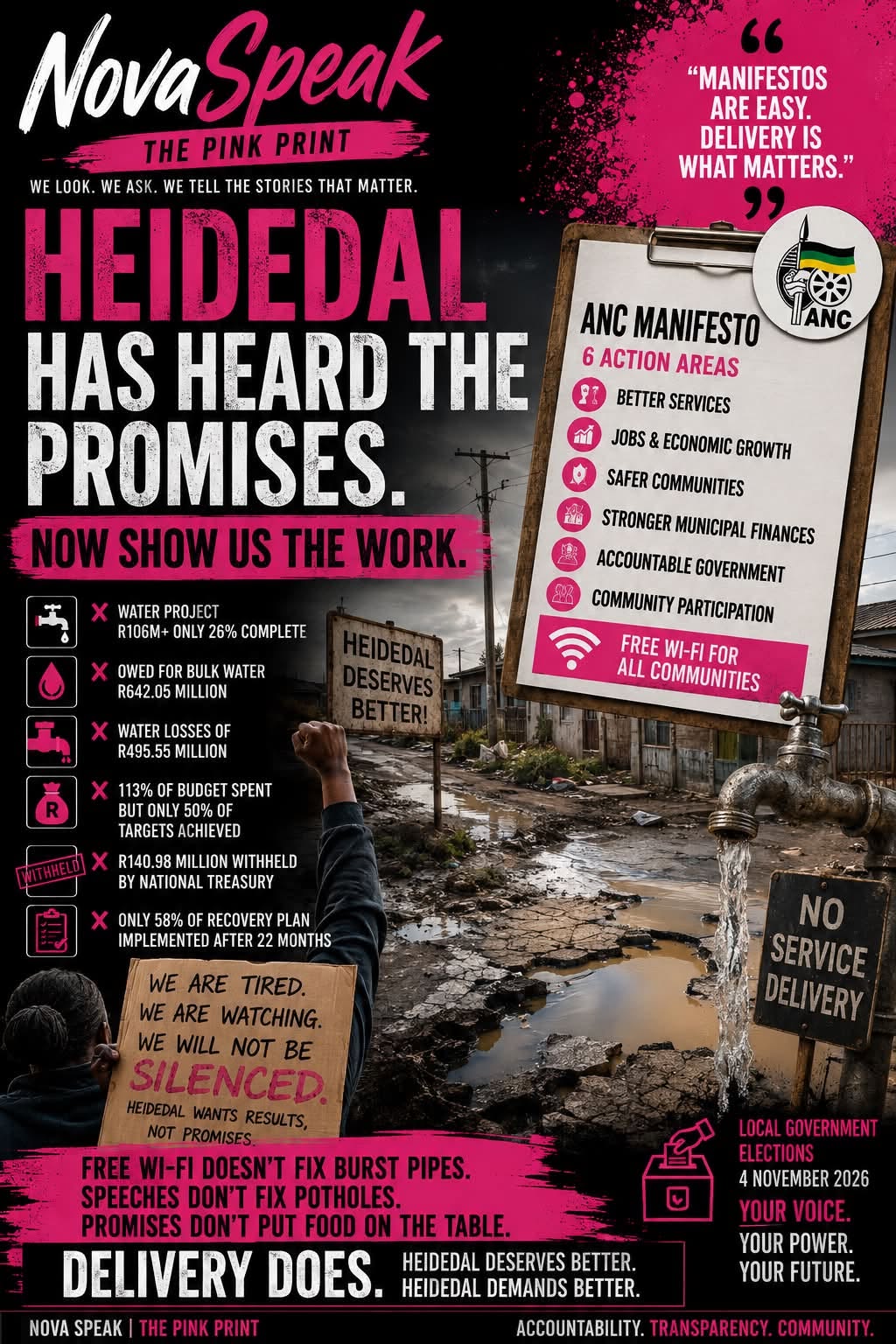
There is something almost uncomfortable about watching the African National Congress unveil another local government manifesto filled with promises of better services, reliable water and electricity, jobs, safer communities, stronger municipal finances, accountable leadership and greater community participation when communities such as Heidedal are still fighting battles that should have been resolved long ago.
On 23 August, ANC president Cyril Ramaphosa stood before thousands of supporters at Riverside Park in Diepsloot and launched the party's 2026 Local Government Elections Manifesto, branded around the message “Masakhe” — let us build. The launch came ahead of the 4 November 2026 elections and was presented as a renewed attempt to rebuild public trust and fix local government. The ANC has identified six central areas: reliable basic services and infrastructure; investment and job creation; safer, cleaner and healthier communities; sustainable municipal finances; capable and ethical local government; and municipalities that listen and account to residents.
On paper, it is difficult to argue with any of that.
Who would oppose reliable water? Who would oppose jobs? Who would not want safer streets, functioning municipalities, clean audits, better infrastructure and politicians who actually listen?
The problem for Heidedal is not the quality of the promises.
It is the history attached to them.
The ANC itself acknowledged at the launch that too many municipalities are failing their residents. Ramaphosa accepted responsibility not only for the progress achieved under ANC-led government, but also for failures and shortcomings where the party governs. He told South Africans that trust has to be earned through concrete action, while promising a monitoring mechanism to track implementation from the beginning of a new term. Each municipality, the ANC says, will have its own manifesto, with implementation monitored through the office of the secretary-general.
That is an important admission.
Because for residents who have spent years listening to political promises, the real issue is no longer whether politicians understand what needs fixing.
They do.
The question is whether they can actually fix it.
And that is where the manifesto meets the uncomfortable reality of Mangaung.
Parliament's Standing Committee on Public Accounts placed the metro under scrutiny after it emerged that Mangaung had spent 113% of its budget while achieving only 50% of its service-delivery targets. Its financial recovery plan was also moving slowly, with only 58% of the Phase 1 rescue activities implemented after years of intervention. Mangaung's own financial statements record an outstanding bulk-water debt of more than R642 million, alongside material water losses.
These are not figures that exist merely to populate parliamentary reports.
They eventually arrive at people's front doors.
They become the resident turning on a tap and wondering what will come out. They become the household waiting for a municipal complaint to be resolved. They become the business owner trying to operate in an environment where infrastructure cannot always be relied upon. They become the unemployed young person hearing politicians speak about economic opportunities while still struggling to find one.
And they become something even more dangerous: lowered expectations.
A broken system becomes something people learn to live with.
A delayed project becomes something residents expect.
A complaint without a response becomes normal.
A pothole becomes part of the landscape.
A burst pipe becomes another WhatsApp message.
A promise without a deadline becomes election language.
That is the real danger facing communities such as Heidedal — not simply that services may fail, but that failure slowly becomes normal.
The ANC's new manifesto appears to recognise that problem. Ramaphosa promised that basic services must be experienced by South Africans every day, not merely discussed during election campaigns. He also pledged improvements to municipal reporting and tracking systems, while promising that ANC-led municipalities would digitise business services and introduce clearer turnaround times for approvals and other municipal processes.
There is also a broader economic promise.
The ANC says it wants municipalities to become engines of investment and job creation, with better infrastructure, stronger local economies and an environment in which businesses can operate and expand. Its manifesto also contains targets around procurement from women-, youth- and disability-owned enterprises and calls for the revitalisation of CBDs, town centres and township business districts.
Again, the ambition is welcome.
But Heidedal should ask a simple question: where will the work be seen?
Will it be seen in the condition of local roads?
Will it be seen in functioning water infrastructure?
Will it be seen through faster responses from municipal departments?
Will it be seen in contracts reaching genuine local businesses?
Will it be seen in young people moving from unemployment into sustainable work rather than temporary political promises?
Will it be seen in a municipality that pays compliant suppliers on time and manages public money properly?
Because economic development cannot survive on a manifesto alone. Businesses need functioning infrastructure. Investors need confidence. Contractors need predictable payment. Residents need roads, water, electricity, sanitation and public spaces that work.
The ANC has also placed municipal finances squarely on the political agenda, promising to review the funding model, improve revenue collection and billing, control expenditure and strengthen procurement and contract management. The party has set a target of reducing municipal debt owed to Eskom and water boards by at least 30% by 2031, while aiming for at least half of municipalities to achieve clean or unqualified audit outcomes.
For Mangaung, that promise carries particular weight.
A municipality carrying hundreds of millions in bulk-water debt cannot simply talk about financial discipline as an abstract principle. Residents need to know what financial discipline will mean when the budget reaches their neighbourhood.
Will it mean fewer incomplete projects?
Will it mean maintenance before infrastructure collapses?
Will it mean consequences when money is wasted?
Will it mean contractors are appointed because they can deliver rather than because they are politically connected?
Will it mean residents can follow the money from the budget to the project site?
And when something goes wrong, will someone be expected to explain it?
That is precisely why the ANC's promise of greater community participation deserves to be tested against reality.
The party says communities must be placed at the centre of municipal decision-making. Its latest messaging emphasises localised manifestos designed around the specific challenges of individual municipalities and says residents should help shape practical solutions.
Then let Heidedal participate meaningfully.
Not simply when a candidate needs a microphone and a crowd.
Not simply when campaign posters go up.
Not simply when politicians arrive with promises.
Let residents see the project plans.
Let them see the budgets.
Let them know the timelines.
Let them know which department is responsible.
Let them know who signed off.
Let them know when construction begins.
Let them know when it must be completed.
And if it is not completed, let somebody explain why.
That demand becomes even more relevant because the ANC's manifesto launch itself contained a revealing political contradiction.
The party had originally planned to formally announce its mayoral candidates on 22 August at the Sandton Convention Centre. Instead, Secretary-General Fikile Mbalula announced that the ANC would present potential candidates and shortlists, with final candidates to be announced later after further vetting and lifestyle audits. More than 200 people had reportedly gone through the selection process.
Mbalula defended the change as part of a new approach to candidate selection, arguing that the ANC wanted people with the qualifications and credentials to manage sophisticated municipal budgets and that the party was entering new territory by changing how mayoral candidates were selected.
That matters because the manifesto repeatedly places leadership at the centre of municipal performance.
Ramaphosa was blunt about it.
A municipality can have budgets, employees and plans, he argued, but if its political leadership is divided, corrupt, weak or indifferent, it will fail. The ANC therefore says it wants capable, ethical and stable municipal leadership, with clearer boundaries between political leadership and administration.
That sounds like exactly what municipalities need.
But it also creates a very simple test for voters.
Who are you putting in charge?
And what happens when those people fail?
That question is particularly important in Mangaung because the ANC remains the governing party in the metro and, according to the ANC's own national manifesto document, Mangaung and Buffalo City were the only metros where it retained outright majorities after the 2021 election. Nationally, the ANC's municipal vote declined from 53.9% in 2016 to 45.59% in 2021, while the number of hung councils increased sharply.
In other words, this election is not taking place in a political vacuum.
The ANC knows it has lost support.
It knows trust has been damaged.
It knows local government performance will be central to whether voters give it another mandate.
And it is not only the ANC's electoral position that is changing.
The traditional political landscape around it is shifting too.
At the Diepsloot launch, ANC national chairperson Gwede Mantashe openly addressed the absence of the South African Communist Party from the official programme, saying the SACP had “walked away” after deciding to contest the elections independently. Cosatu and Sanco were recognised at the event, while the SACP was no longer treated as part of the ANC's campaign platform.
That development may seem distant from Heidedal.
It is not.
It tells voters something about the election ahead: old alliances are changing, traditional loyalties are being tested and parties are increasingly being forced to make their own case directly to voters.
Even the ANC's own leadership picture carried uncertainty. Deputy President Paul Mashatile was notably absent from the manifesto launch because of health reasons, while Ramaphosa was flanked by members of the ANC's National Executive Committee as he delivered the party's central message.
But beneath all of that political theatre is a much simpler reality.
The people living in Heidedal do not experience politics through NEC meetings.
They experience it through municipal services.
They experience it when the water stops.
When the street deteriorates.
When a business closes.
When a young person cannot find work.
When a complaint disappears into a municipal system.
When a community facility deteriorates.
When residents have to organise themselves to demand what should already be working.
That is why free Wi-Fi, digital platforms and technology should not be dismissed — they can be valuable tools for inclusion and access — but neither should they become substitutes for the foundations of a functioning municipality.
Technology cannot repair a burst pipe by itself.
An app cannot resurface a road.
A digital complaint system means little if nobody arrives to resolve the complaint.
And free Wi-Fi cannot become a symbol of progress while the infrastructure beneath the community continues to fail.
The ANC's manifesto says it wants to reclaim hijacked buildings, tackle slumlords, fight illegal dumping, improve safety around schools and transport areas, maintain street lighting, parks, sports facilities and community halls, and make communities safer and more liveable.
Those are serious challenges, and Heidedal knows them intimately.
But the standard must remain the same:
Show us.
Show residents the plan.
Show them the budget.
Show them the people responsible.
Show them the deadline.
Then show them the result.
Because there is a difference between a political promise and a public commitment.
A promise asks you to believe.
A commitment gives you something against which performance can be measured.
That distinction should define this election.
NovaSpeak is not arguing that every promise contained in the ANC manifesto is worthless. Quite the opposite. Reliable services, safer communities, stronger local economies, accountable government and functioning infrastructure are precisely the things residents should demand from whoever seeks their vote.
But a good manifesto cannot be judged by how impressive it sounds when launched from a stage.
It must be judged by what happens after the microphones are packed away.
That is where Heidedal comes in.
Because residents should not have to wait another five years to discover whether the promises were serious.
They should be able to measure progress month by month.
Project by project.
Budget by budget.
Ward by ward.
And politician by politician.
The ANC has now asked South Africans to trust its renewed commitment to local government. Ramaphosa has acknowledged the failures. The party says it has learned from the shortcomings of the past and promises stronger monitoring, better leadership, improved services, greater community participation and more disciplined municipal finances.
Good.
Then let the promises be written down.
Let the deadlines be public.
Let the performance be visible.
Let the failures be explained.
And let the voters decide what the record deserves.
Because Heidedal has spent enough time listening.
It has heard the speeches.
It has seen the campaign posters.
It has watched the promises arrive, year after year, election after election.
Now the political parties are asking for another mandate.
So bring the manifestos.
Bring the slogans.
Bring the candidates.
Bring the promises.
But understand what has changed.
Heidedal is no longer simply listening.
It is watching.
It is questioning.
It is remembering.
And it is keeping score.
Because when a community has been promised better for long enough, words eventually lose their currency.
The only thing that can restore their value is delivery.
Not next year.
Not after another five-year plan.
Not when the next election approaches.
Now.
Heidedal has heard the promises.
Now show us the work.
NovaSpeak | The Pink Print
We Look. We Ask. We Tell The Stories That Matter.