Community
CLIVE SOLOMON STADIUM: WHEN HEIDEDAL HAS TO WATCH THE WATCHMEN
A community tried to save its stadium. Now allegedly stolen fencing raises a bigger question: why is Heidedal being left to maintain what belongs to the municipality?
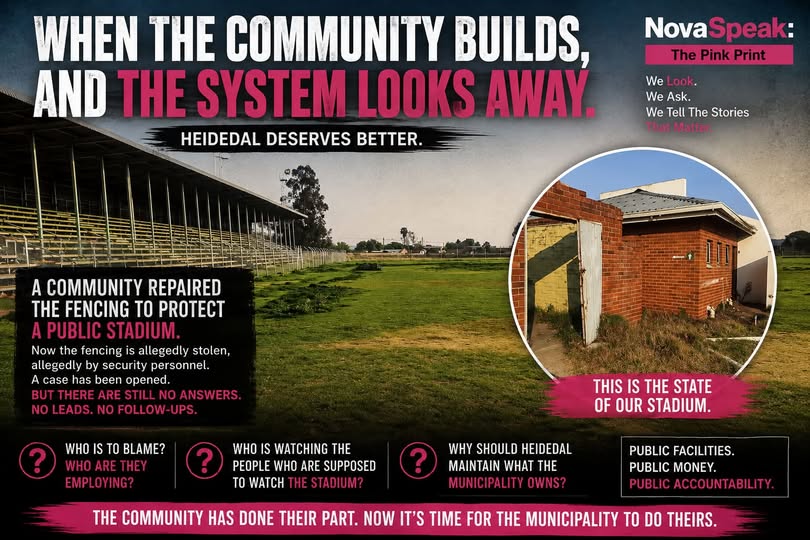
A community tried to save its stadium. Now the alleged theft of repaired fencing is raising uncomfortable questions about municipal neglect, security and who is ultimately responsible for protecting Heidedal’s public assets.
By Bernell Simons | NovaSpeak Investigations — The Pink Print
At first glance, it is a story about a fence.
But at Clive Solomon Stadium in Heidedal, a fence may be the smallest part of the story.
Behind the alleged disappearance of repaired fencing lies a more uncomfortable question about the state of a municipal facility, the role residents have increasingly been forced to play in protecting it, and whether the systems meant to safeguard public infrastructure are working at all.
The stadium is supposed to belong to the community.
It is supposed to provide a space where children can play, sporting organisations can operate and young people can develop their talents.
Yet residents have increasingly found themselves doing something they should never have had to do on this scale: trying to protect and improve a municipal facility themselves.
Over time, concerns have been raised about the stadium's condition, including overgrown vegetation, deteriorating infrastructure and fencing problems. In 2025, calls were made for urgent intervention, while community members and sporting organisations took steps of their own to improve parts of the facility.
That community involvement is important.
It demonstrates that people care.
But it also creates an uncomfortable contradiction.
If residents are forced to raise money, organise repairs and physically intervene to protect a municipal facility, where does community participation end and municipal responsibility begin?
That question has become even more pressing following information received by NovaSpeak that fencing repaired through community efforts has allegedly been stolen.
A criminal case has reportedly been opened.
There are also allegations that security personnel may have been involved.
Those allegations remain allegations. NovaSpeak has not independently established that any security employee was responsible, and no individual should be identified or condemned without evidence. The investigation must be allowed to establish what happened and who, if anyone, was responsible.
But the existence of an investigation does not remove the public-interest questions surrounding the incident.
In fact, it makes them more urgent.
A STADIUM THE COMMUNITY REFUSED TO ABANDON
For residents, Clive Solomon Stadium is more than municipal property listed on an asset register.
It is part of Heidedal.
It is a sporting space, a gathering point and a place connected to the aspirations of young people in the area.
That is why the condition of the facility matters.
When public infrastructure deteriorates, the consequences are not simply aesthetic. A broken fence can compromise security. Overgrown vegetation can create additional risks. Poorly maintained infrastructure can discourage legitimate use of the facility and create opportunities for vandalism and theft.
And when residents begin stepping in to address those problems, they can create a strange situation in which the people who use the facility become increasingly responsible for keeping it functioning.
That appears to be part of the story at Clive Solomon Stadium.
Residents and sporting organisations have attempted to fill gaps through community action.
But community action should not obscure the institutional responsibility of the municipality.
A resident cleaning a public facility because they care about their neighbourhood is civic participation.
A sporting organisation raising funds because it wants children to have better facilities is community spirit.
But when those interventions become necessary because municipal maintenance is inadequate, the question changes.
It becomes a governance issue.
THEN THE FENCE DISAPPEARED
This is where the alleged theft becomes significant.
A community that has already invested effort and resources into improving a municipal facility now reportedly finds itself dealing with the disappearance of infrastructure that had been repaired.
The obvious question is: how did that happen?
But an investigation cannot stop there.
If the stadium is secured, who had access?
If security personnel are stationed there, what were their responsibilities?
If there are supervisors, how frequently did they inspect the facility?
If CCTV exists, was footage reviewed?
If access is controlled, are there records showing who entered and left?
If fencing was removed, when was it last confirmed to be intact?
When was the loss discovered?
Who reported it?
How quickly was the municipality informed?
And what happened after the criminal case was opened?
These are not accusations.
They are basic investigative questions.
They are the questions any system responsible for protecting public property should be able to answer.
If the answers do not exist, that raises another question: what exactly is the public paying for?
THE SECURITY QUESTION
Security at public facilities is often treated as a background issue until something goes wrong.
But once municipal property allegedly disappears, security becomes central to the story.
If Mangaung Metropolitan Municipality employs or contracts security services at public facilities, there should be a clear understanding of what those services are expected to achieve.
Protection of the facility should presumably form part of that responsibility.
But effective security is not simply about placing a person at a gate.
It involves supervision, access control, inspections, reporting procedures and accountability.
When something disappears, the system should be able to reconstruct what happened.
Who was on duty?
What did they observe?
Were patrols conducted?
Were incidents recorded?
Were supervisors notified?
Was the relevant security company contacted?
Was an internal municipal investigation initiated?
And if negligence is suspected, what consequences follow?
These questions become particularly important when community members themselves have invested resources into repairing the facility.
Because the fencing is not simply material.
It represents public money, community effort and an attempt to prevent the stadium from deteriorating further.
If that infrastructure is lost, the financial consequences ultimately return to the public.
PAYING TWICE FOR THE SAME PROBLEM
There is a larger municipal principle at stake.
When infrastructure is properly maintained, it can serve communities for years.
When it is neglected, deterioration increases the eventual repair bill.
When repaired infrastructure is then allegedly stolen or vandalised, another expense follows.
The public can therefore end up paying repeatedly for the same asset.
First to build it.
Then to repair it.
Then potentially to replace what was lost.
That is why public-asset management cannot be treated as an administrative detail.
Municipalities are custodians of assets that belong to the public.
Those assets require proper maintenance, protection and oversight.
Clive Solomon Stadium is therefore not merely a Heidedal sporting issue.
It is a test of municipal asset management.
WHERE DOES GOVERNMENT RESPONSIBILITY BEGIN?
Perhaps the most revealing part of this story is not the alleged theft itself.
It is the circumstances that preceded it.
Why did residents feel compelled to intervene?
Why were community members and sporting organisations contributing time and resources to a municipal facility?
And why has the community repeatedly had to raise concerns about the condition of the stadium?
There is nothing wrong with residents helping their communities.
In fact, communities should be encouraged to take ownership of their neighbourhoods.
But there is a line between community ownership and government abdication.
When residents voluntarily help, government should welcome that contribution while continuing to fulfil its responsibilities.
When residents have to help because the municipality is not doing enough, government needs to ask why.
The danger is that community resilience can sometimes conceal institutional failure.
A community fixes the fence, so the municipality does not have to.
Residents clean the grounds, so the deterioration becomes less visible.
Sporting organisations raise funds, reducing pressure on municipal budgets.
People volunteer their time, and the system continues.
Everyone celebrates the community.
But nobody asks why the community had to step in.
That is precisely the question NovaSpeak believes deserves closer examination.
THE PAPER TRAIL
A proper investigation into Clive Solomon Stadium should not rely solely on what can be seen from outside the gates.
There should be a paper trail.
Municipal records should show who is responsible for the facility.
Maintenance records should indicate when repairs were requested and completed.
Procurement records could establish whether contractors were appointed for maintenance or security.
Security contracts should outline the obligations of personnel stationed at the stadium.
Incident reports should indicate whether previous theft or vandalism occurred.
The criminal case, if opened as reported, should provide another part of the timeline.
Together, these records could answer a basic question:
Was the alleged theft an isolated criminal incident, or did weaknesses in the management and protection of the stadium create an environment in which public infrastructure was vulnerable?
That distinction matters.
Because replacing a fence deals with the physical damage.
It does not necessarily deal with the system that allowed the damage to occur.
THE MUNICIPALITY HAS QUESTIONS TO ANSWER
For Mangaung Metropolitan Municipality, the issue presents an opportunity to demonstrate transparency.
The municipality should be able to explain the current condition of Clive Solomon Stadium, the maintenance responsibilities attached to the facility, the security arrangements in place and what action was taken following the alleged theft.
Residents also deserve clarity about the extent of municipal involvement in the repairs that preceded the alleged theft.
Were the repairs formally recorded?
Was the municipality aware that community members were undertaking work?
Was the municipality asked to intervene?
What maintenance budget is allocated to the facility?
How frequently is the stadium inspected?
What security measures are currently operational?
And what is being done to prevent further losses?
These are legitimate public-interest questions because the stadium is a public asset.
The answers should therefore be public.
MORE THAN A FENCE
There is a tendency in municipal reporting to treat incidents such as stolen fencing as isolated events.
A fence disappears.
A report is opened.
A replacement is requested.
And life moves on.
But investigative journalism requires looking at what sits behind the incident.
At Clive Solomon Stadium, the alleged theft opens a window into a much larger story about municipal maintenance, community resilience, public-asset protection and accountability.
The people of Heidedal have demonstrated that they care about their stadium.
They have not simply walked away.
They have tried to repair what is broken.
They have contributed where they could.
They have raised concerns.
They have continued to use and support the facility.
But there is a limit to what a community can reasonably be expected to do.
Residents can help maintain their neighbourhood.
They cannot become the municipality's maintenance department.
They can report crime.
They cannot become the municipality's security service.
They can demand answers.
They cannot be expected to conduct investigations into missing public property themselves.
And they should not have to spend their own money repeatedly restoring infrastructure that is supposed to be maintained through public resources.
Clive Solomon Stadium should be a symbol of what Heidedal can offer its young people.
Instead, it risks becoming a symbol of what happens when a community is forced to compensate for weaknesses in the systems responsible for serving it.
That is why the story cannot end with a missing fence.
The real investigation is about responsibility.
Who maintains the stadium?
Who secures it?
Who monitors it?
Who records its condition?
Who investigates when something goes missing?
Who pays when it has to be replaced?
And ultimately, who answers to the people of Heidedal?
The community has already shown that it is watching.
Now it is time to ask whether the people entrusted with watching over the stadium are being watched themselves.
Because the fence may be missing — but the bigger question is whether accountability is missing too.
NovaSpeak Investigations | The Pink Print
We Look. We Ask. We Tell The Stories That Matter.